Overview
An outer join that SQL writes with a single LEFT JOIN clause required composing three methods in LINQ — GroupJoin, SelectMany and DefaultIfEmpty — for over a decade.
.NET 10 finally closes that gap by adding LeftJoin and RightJoin as first-class operators.
Alongside them, random reordering — long imitated with the OrderBy(_ => Guid.NewGuid()) pseudo-idiom — was standardized as Shuffle.
Starting from the correspondence between SQL join clauses and LINQ idioms, this article implements polyfills that make the three operators available on .NET Framework.
It then digs into a concern unique to this backport, born from the fact that outer joins live next door to database queries: applying the polyfill to IQueryable<T> silently breaks query translation.
Prerequisites / Environment
- Frameworks: .NET Framework 4.8 (backport target) / .NET 10+ (future migration target)
- APIs: LINQ
LeftJoin(2 signatures),RightJoin(2 signatures),Shuffle(1 signature) - Approach: apply
#nullable enable; disable automatically on migration via#if !NET10_0_OR_GREATER - Language version: nullable annotations on unconstrained type parameters (
TInner?/TOuter?) requireLangVersion9.0 or later (recommended:latest). No other project configuration changes - Verification environment: .NET 10 / Windows 11
The polyfill implementation in this article was built and run for both net48 and net10.0 in the environment above, and the outputs were compared.
On net10.0 the migration #if guard disables the polyfill, so the BCL implementation is used.
The following points were confirmed in that environment:
- The default value that
LeftJoin/RightJoinpass for a row with no counterpart matches on both targets. Shufflereturns a permutation of the original sequence (compared after sorting, since the order is random).
How SQL Join Clauses Map to LINQ Idioms
The three operators added in .NET 10 are the following.
| Method | Added in | Corresponding operation |
|---|---|---|
LeftJoin<TOuter, TInner, TKey, TResult> |
.NET 10.0 | SQL LEFT OUTER JOIN (keeps every outer element) |
RightJoin<TOuter, TInner, TKey, TResult> |
.NET 10.0 | SQL RIGHT OUTER JOIN (keeps every inner element) |
Shuffle<TSource> |
.NET 10.0 | Random reordering |
LINQ before .NET 10 has no dedicated outer-join operator — only Join (inner join).
An operation that SQL expresses in one clause mapped to this:
-- SQL: keep employees with no matching department
SELECT e.Name, d.DeptName
FROM Employee e
LEFT JOIN Department d ON e.DeptId = d.DeptId
// LINQ (.NET 9 and earlier): composing GroupJoin + SelectMany + DefaultIfEmpty
var result = employees
    .GroupJoin(departments, e => e.DeptId, d => d.DeptId, (e, ds) => new { e, ds })
    .SelectMany(g => g.ds.DefaultIfEmpty(), (g, d) => new { g.e.Name, d?.DeptName });
The composed idiom buries the intent — “outer join” — in structure, and misplacing SelectMany or DefaultIfEmpty quietly turns it into an inner or cross join.
Random ordering has the same shape of problem: OrderBy(_ => Guid.NewGuid()) generates a key per element, pays for a full sort, and offers no uniformity guarantee as a shuffle.
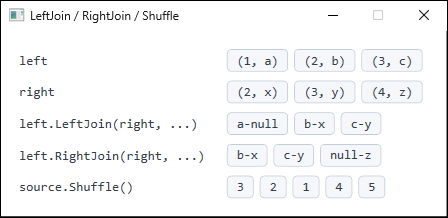
LeftJoin keeps the left side and fills the counterpart with null; RightJoin does the reverse. Shuffle randomizes the order, so that row shows the result of a single run.Implementation
The following is the complete polyfill for LeftJoin (2 signatures), RightJoin (2 signatures) and Shuffle (1 signature).
LeftJoin / RightJoin embed the composition idiom above in the same shape as the built-ins, and Shuffle buffers the source into an array before applying a Fisher–Yates shuffle.
The reasons for placing the polyfill in System.Linq and for the migration guard are covered in the series foundation article.
Add it to the project as, for example, LinqExtensions.Net10.cs.
#nullable enable

using System;
using System.Collections.Generic;

#if !NET10_0_OR_GREATER // Active only below .NET 10.0 (e.g. .NET Framework)

namespace System.Linq
{
    /// <summary>
    /// Provides extension methods that backfill LINQ methods introduced in .NET 10.0 for older target frameworks.
    /// </summary>
    public static partial class LinqExtensions
    {
        // ==========================================
        // 1. LeftJoin (left outer join)
        // ==========================================
        public static IEnumerable<TResult> LeftJoin<TOuter, TInner, TKey, TResult>(
            this IEnumerable<TOuter> outer,
            IEnumerable<TInner> inner,
            Func<TOuter, TKey> outerKeySelector,
            Func<TInner, TKey> innerKeySelector,
            Func<TOuter, TInner?, TResult> resultSelector)
            => outer.LeftJoin(inner, outerKeySelector, innerKeySelector, resultSelector, comparer: null);

        public static IEnumerable<TResult> LeftJoin<TOuter, TInner, TKey, TResult>(
            this IEnumerable<TOuter> outer,
            IEnumerable<TInner> inner,
            Func<TOuter, TKey> outerKeySelector,
            Func<TInner, TKey> innerKeySelector,
            Func<TOuter, TInner?, TResult> resultSelector,
            IEqualityComparer<TKey>? comparer)
        {
            if (outer == null) throw new ArgumentNullException(nameof(outer));
            if (inner == null) throw new ArgumentNullException(nameof(inner));
            if (outerKeySelector == null) throw new ArgumentNullException(nameof(outerKeySelector));
            if (innerKeySelector == null) throw new ArgumentNullException(nameof(innerKeySelector));
            if (resultSelector == null) throw new ArgumentNullException(nameof(resultSelector));

            // Group matching inner elements per outer element; supply default(TInner) when none match.
            return outer
                .GroupJoin(inner, outerKeySelector, innerKeySelector, (o, inners) => new { o, inners }, comparer)
                .SelectMany(g => g.inners.DefaultIfEmpty(), (g, i) => resultSelector(g.o, i));
        }

        // ==========================================
        // 2. RightJoin (right outer join)
        // ==========================================
        public static IEnumerable<TResult> RightJoin<TOuter, TInner, TKey, TResult>(
            this IEnumerable<TOuter> outer,
            IEnumerable<TInner> inner,
            Func<TOuter, TKey> outerKeySelector,
            Func<TInner, TKey> innerKeySelector,
            Func<TOuter?, TInner, TResult> resultSelector)
            => outer.RightJoin(inner, outerKeySelector, innerKeySelector, resultSelector, comparer: null);

        public static IEnumerable<TResult> RightJoin<TOuter, TInner, TKey, TResult>(
            this IEnumerable<TOuter> outer,
            IEnumerable<TInner> inner,
            Func<TOuter, TKey> outerKeySelector,
            Func<TInner, TKey> innerKeySelector,
            Func<TOuter?, TInner, TResult> resultSelector,
            IEqualityComparer<TKey>? comparer)
        {
            if (outer == null) throw new ArgumentNullException(nameof(outer));
            if (inner == null) throw new ArgumentNullException(nameof(inner));
            if (outerKeySelector == null) throw new ArgumentNullException(nameof(outerKeySelector));
            if (innerKeySelector == null) throw new ArgumentNullException(nameof(innerKeySelector));
            if (resultSelector == null) throw new ArgumentNullException(nameof(resultSelector));

            // GroupJoin pivoted on the inner sequence; supply default(TOuter) when none match.
            return inner
                .GroupJoin(outer, innerKeySelector, outerKeySelector, (i, outers) => new { i, outers }, comparer)
                .SelectMany(g => g.outers.DefaultIfEmpty(), (g, o) => resultSelector(o, g.i));
        }

        // ==========================================
        // 3. Shuffle (random reordering)
        // ==========================================
        public static IEnumerable<TSource> Shuffle<TSource>(this IEnumerable<TSource> source)
        {
            if (source == null) throw new ArgumentNullException(nameof(source));
            return ShuffleIterator(source);
        }

        private static IEnumerable<TSource> ShuffleIterator<TSource>(IEnumerable<TSource> source)
        {
            var buffer = source.ToArray();

            // Fisher–Yates: swap each position from the tail with an undecided element.
            for (int i = buffer.Length - 1; i > 0; i--)
            {
                int j = SharedRandom.Next(i + 1);
                if (j != i)
                {
                    (buffer[i], buffer[j]) = (buffer[j], buffer[i]);
                }
            }

            foreach (var item in buffer)
            {
                yield return item;
            }
        }

#if NET6_0_OR_GREATER
        // .NET 6+ provides a thread-safe shared instance.
        private static Random SharedRandom => Random.Shared;
#else
        // .NET Framework has no Random.Shared, so keep one instance per thread.
        [ThreadStatic]
        private static Random? _threadRandom;
        private static Random SharedRandom => _threadRandom ??= new Random();
#endif
    }
}

#endif
Whether this implementation returns what the standard LINQ returns can be checked by building the same calling code for net48 (polyfill active) and for net10.0 (built-in active), running both, and comparing the output.
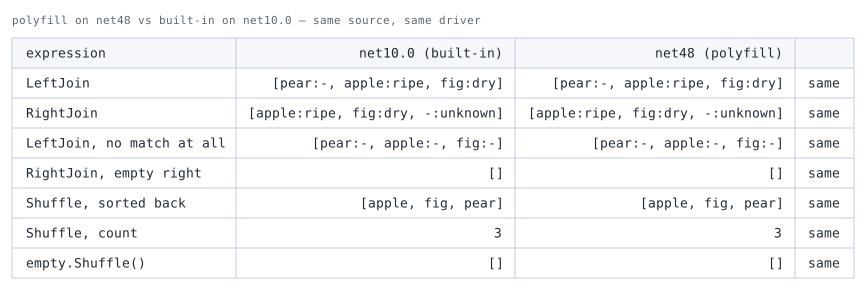
net48 and built for net10.0 where #if switches it to the built-in, run through one and the same driver. Measured with .NET SDK 10.0.302.Shuffle draws on randomness, so its output is re-sorted before the comparison. The two sides also agree on the default value handed to a row that has no counterpart.
The result selectors of LeftJoin / RightJoin carry the same nullable annotations as the built-ins — TInner? for LeftJoin, TOuter? for RightJoin.
The signature itself thus documents which side can be missing, and nullable analysis agrees before and after migration.
Shuffle’s random source branches further on a nested #if NET6_0_OR_GREATER: where Random.Shared is unavailable, a [ThreadStatic] instance provides thread safety.
Using LeftJoin / RightJoin
LeftJoin: Keep Every Outer (Left) Element
For outer elements with no matching inner element, the result selector receives default(TInner) (null for reference types) as its second argument.
var employees = new[]
{
    new { Name = "Sato",      DeptId = 10 },
    new { Name = "Suzuki",    DeptId = 20 },
    new { Name = "Takahashi", DeptId = 99 }, // No matching department
};

var departments = new[]
{
    new { DeptId = 10, DeptName = "Sales" },
    new { DeptId = 20, DeptName = "Engineering" },
};

var result = employees.LeftJoin(
    departments,
    e => e.DeptId,
    d => d.DeptId,
    (e, d) => $"{e.Name}: {d?.DeptName ?? "(unassigned)"}");
// Sato: Sales
// Suzuki: Engineering
// Takahashi: (unassigned)
Matching SQL’s LEFT JOIN ... ON e.DeptId = d.DeptId, the unmatched “Takahashi” stays in the output.
The second selector argument d is nullable and must be null-checked before use.
RightJoin: Keep Every Inner (Right) Element
For inner elements with no matching outer element, the result selector receives default(TOuter) as its first argument.
var employees = new[]
{
    new { Name = "Sato",   DeptId = 10 },
    new { Name = "Suzuki", DeptId = 20 },
};

var departments = new[]
{
    new { DeptId = 10, DeptName = "Sales" },
    new { DeptId = 20, DeptName = "Engineering" },
    new { DeptId = 30, DeptName = "General Affairs" }, // No employees assigned
};

var result = employees.RightJoin(
    departments,
    e => e.DeptId,
    d => d.DeptId,
    (e, d) => $"{d.DeptName}: {e?.Name ?? "(vacant)"}");
// Sales: Sato
// Engineering: Suzuki
// General Affairs: (vacant)
RightJoin(outer, inner, ...) preserves every element of inner, symmetric to LeftJoin; the implementation simply pivots the GroupJoin onto the inner sequence.
Shuffle versus Pseudo-Shuffles
Random ordering via OrderBy(_ => Guid.NewGuid()) is widespread but carries two problems.
It generates a GUID per element and pays for an $O(n \log n)$ sort, and the distribution of generated GUIDs as sort keys guarantees no uniformity of the resulting permutation.
Shuffle uses Fisher–Yates, producing each permutation with equal probability in a single $O(n)$ pass.
var deck = Enumerable.Range(1, 52);

var shuffled = deck.Shuffle().ToArray();
// e.g. [17, 3, 50, 28, ...] (differs per call)
Shuffle is deferred, but like OrderBy it buffers the entire source before yielding the first element.
var query = Enumerable.Range(1, 3).Shuffle();

var first = query.ToArray();  // Source is enumerated and shuffled here
var second = query.ToArray(); // Re-enumerating yields a different order
Because deferred queries re-shuffle on every enumeration, materialize once with ToArray / ToList when a fixed order is needed.
The randomness is non-cryptographic; for lotteries or anything requiring unpredictability, use System.Security.Cryptography randomness instead.
The IQueryable<T> Pitfall
Outer joins live next door to database queries, which gives this polyfill a risk the other backports do not have.
It extends Enumerable (IEnumerable<T>), but IQueryable<T> inherits IEnumerable<T>, so the compiler happily applies it to Entity Framework queries too.
What happens then is not a runtime error but silent performance degradation.
With no Queryable counterpart available, the Enumerable polyfill binds, and the join is never translated to SQL — it executes client-side.
Entire tables are transferred and joined in memory, and nothing looks wrong until data volume grows.
For server-side outer joins in database queries below .NET 10, keep writing the provider-translatable GroupJoin(...).SelectMany(..., DefaultIfEmpty()) form.
AsEnumerable only draws the client-evaluation boundary; it does not keep the join on the server.
.NET 10 does add LeftJoin / RightJoin to Queryable as well, but their translatability depends on the provider, and this article’s scope is Enumerable only.
Migration Guard
The polyfill is wrapped in #if !NET10_0_OR_GREATER.
LeftJoin, RightJoin and Shuffle do not exist before .NET 10, so the wrong guard breaks compilation. !NETCOREAPP disables the polyfill on every target where NETCOREAPP is defined (.NET Core and .NET 5–9), whereas !NET9_0_OR_GREATER disables it only on net9.0 and later (on .NET 8 the NET9_0_OR_GREATER symbol is undefined, so the polyfill stays active; on .NET 9 it is disabled and fails to compile). Both switch the polyfill off where the operators are missing, so the correct guard is #if !NET10_0_OR_GREATER.
The general rule — disable at and above the version that introduced the methods — is laid out in the .NET 6 backport article.
Caveats
- Join direction:
LeftJoinpreserves every element of the first argument (outer);RightJoinpreserves every element of the second (inner). The nullable selector argument is the inner element forLeftJoinand the outer element forRightJoin— null-check before use. - Key equality: the comparer-free overloads use
EqualityComparer<TKey>.Default. Pass anIEqualityComparer<TKey>for case-insensitive joins and the like. Delegation from the smaller overloads pins resolution with the named argumentcomparer:(the same technique used in the ToDictionary backport). Shufflecannot handle infinite sequences: the entire source is buffered at enumeration start, so an unbounded sequence never completes.- Compile with C# 9 or later: the nullable annotations on unconstrained type parameters (
TInner?/TOuter?) fail with errors such asCS8627under the .NET Framework 4.8 defaultLangVersion(7.3). Set<LangVersion>9.0</LangVersion>(orlatest) in the.csproj. - No name collisions: these signatures do not exist in .NET Framework, and they differ from
JoinandOrderByin name and parameters, so overload resolution is unaffected.
Alternatives / Comparison
| Approach | Pros | Cons | Best for |
|---|---|---|---|
| Hand-rolled polyfill (this article) | No dependency; the name states the SQL-equivalent intent | The IQueryable misapplication risk must be managed |
Mostly in-memory joins and shuffles |
Write GroupJoin + DefaultIfEmpty inline |
No extra code; translates under IQueryable too |
Verbose; easy to get subtly wrong | Outer joins in database queries |
Substitute OrderBy(_ => Guid.NewGuid()) |
No extra code | Inefficient; no uniformity guarantee | Small collections where rigor is irrelevant |
| Adopt MoreLINQ or similar | Implemented and tested | External dependency; API differs from the built-ins | Projects already accepting the dependency |
| Upgrade to .NET 10 | Root fix; Queryable versions available |
Migration cost | When migration is feasible |
Until a .NET 10 migration, the pragmatic split is: polyfill for in-memory collections, classic GroupJoin idiom for database queries.
Summary
.NET 10’s LeftJoin, RightJoin and Shuffle promote operations that were standard in SQL — or imitated through pseudo-idioms — to first-class LINQ operators.
The backport rests on three points.
LeftJoin/RightJoinembed the classicGroupJoin+SelectMany+DefaultIfEmptyidiom and use nullable annotations to state which side can be missingShuffleperforms a uniform Fisher–Yates shuffle, fixing both the inefficiency and the bias ofGuid.NewGuid()sorting- The polyfill is
Enumerable-only; applied to anIQueryable<T>database query it falls back to client evaluation — keep the classic idiom for database queries
| Method | Side preserved | Nullable selector argument | Evaluation |
|---|---|---|---|
LeftJoin |
Outer (left) | Inner element TInner? |
Deferred |
RightJoin |
Inner (right) | Outer element TOuter? |
Deferred |
Shuffle |
— | — | Deferred (full buffering at enumeration) |
Related Articles
- Designing LINQ Polyfills That Preserve Lazy Evaluation — Implementing Append, Prepend, TakeLast and SkipLast
- Replacing GroupBy and Full-Sort Workarounds — Implementing Chunk, MaxBy, MinBy and DistinctBy
- Order and OrderDescending by Pure Delegation — A Minimal Polyfill with IOrderedEnumerable Compatibility
- Selector-Free ToDictionary — Designing for Overload Resolution and the notnull Constraint
- Key-Based Aggregation Without GroupBy — Dictionary-Backed CountBy, AggregateBy and Index