Overview
To count elements per key, GroupBy builds a full list of elements for every key in memory.
The final result is just key/number pairs — the grouped element bodies are thrown away.
CountBy and AggregateBy, added in .NET 9, skip that intermediate grouping and aggregate by holding only per-key state in a dictionary.
The third addition, Index, turns the Select((x, i) => …) idiom for indexed enumeration into a dedicated method.
This article backports the three methods to .NET Framework.
Its central theme is why the polyfill’s internals should use the same dictionary-based accumulation as the built-in implementation instead of delegating to GroupBy.
The two approaches differ not just in memory efficiency but in how they treat null keys, and the implementation is built by comparing them.
Prerequisites / Environment
- Frameworks: .NET Framework 4.8 (backport target) / .NET 9+ (future migration target)
- APIs: LINQ
CountBy,AggregateBy,Indexand their overloads - Approach: apply
#nullable enable; disable automatically on migration via#if !NET9_0_OR_GREATER - Language version:
#nullable enableandwhere TKey : notnullrequire C# 8.0+. The .NET Framework 4.8 default is C# 7.3, so setLangVersionto8.0or later in the.csproj - Verification environment: .NET 10 / Windows 11
The polyfill implementation in this article was built and run for both net48 and net10.0 in the environment above, and the outputs were compared.
On net10.0 the migration #if guard disables the polyfill, so the BCL implementation is used.
The following points were confirmed in that environment:
CountByandAggregateByreturn keys in first-seen order.- The contents of the tuple returned by
Index, and its result for an empty sequence, match on both targets.
Problem: The Hidden Allocations of GroupBy Aggregation
The following methods added in .NET 9 are unavailable on .NET Framework.
| Method | Added in | Description |
|---|---|---|
CountBy |
.NET 9.0 | Counts elements per key, returning a sequence of KeyValuePair<TKey, int> |
AggregateBy |
.NET 9.0 | Folds elements per key, returning a sequence of KeyValuePair<TKey, TAccumulate> |
Index |
.NET 9.0 | Attaches an index to each element, returning (int Index, TSource Item) tuples |
Writing the equivalent aggregation without them goes through GroupBy.
// Count per key via GroupBy
var counts = words.GroupBy(w => w)
                  .Select(g => new { g.Key, Count = g.Count() });
The invisible cost of this code is the intermediate grouping.
GroupBy walks all elements up front and builds, for every key, a list of references to all elements belonging to that key.
When only a count is needed, those lists are ultimately discarded — but not the moment Count() returns: they stay retained until the entire sequence returned by GroupBy has been enumerated (every key’s group built).
For a million elements across ten keys, a grouping holding a million references stays in memory for the whole time it takes to produce the ten numbers.
The Index substitute — Select((item, index) => (index, item)) — is a different kind of problem: not cost, but intent buried in boilerplate.
Root Cause / Background
GroupBy builds element lists because its contract is to return IGrouping<TKey, TSource> — a sequence of elements per key.
That is not a defect of GroupBy; the defect was paying for that contract in call sites that only aggregate.
.NET 9’s CountBy / AggregateBy introduce an aggregation-only contract — per-key state (a count or an accumulator) is all that needs to be kept — and internally accumulate into a Dictionary.
Because of that internal dictionary, both built-ins constrain where TKey : notnull and throw at enumeration time if a key is null.
Solution: Direct Dictionary Accumulation, Not GroupBy Delegation
There are two candidate internals for the polyfill.
// Option A: naive delegation to GroupBy
public static IEnumerable<KeyValuePair<TKey, int>> CountBy<TSource, TKey>(
    this IEnumerable<TSource> source, Func<TSource, TKey> keySelector)
    => source.GroupBy(keySelector)
             .Select(g => new KeyValuePair<TKey, int>(g.Key, g.Count()));
Option A is shorter but diverges from the built-in behavior on two counts.
| Aspect | GroupBy delegation (A) | Direct dictionary accumulation (B, this article) | Built-in .NET 9 |
|---|---|---|---|
| Memory | Builds per-key element lists | Holds per-key state only | Holds per-key state only |
null keys |
Accepted as one group | ArgumentNullException at enumeration |
ArgumentNullException at enumeration |
GroupBy accepts null keys as a group of their own, so the delegating implementation silently passes input that the built-in would reject.
Since the whole point of a polyfill is to keep behavior unchanged across migration, option B — the same dictionary-based accumulation as the built-in — wins on exception fidelity as well as memory.
To keep lazy evaluation while validating arguments eagerly, the public methods are split from the yield return iterator bodies (see principle 1 of the foundation article).
Index alone involves no aggregation and is served by delegating to the indexed overload of Select.
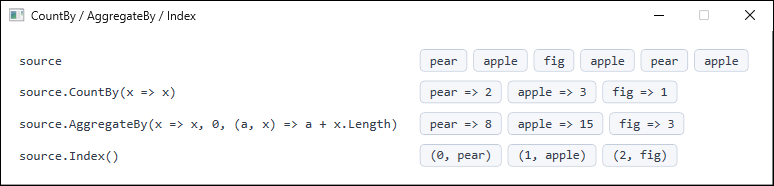
CountBy and AggregateBy fold the sequence down to one entry per key, whereas Index keeps the element count and attaches a position. The Index() row shows only the first three results.Implementation
The following is the complete polyfill — 4 signatures including the seed and seedSelector forms of AggregateBy.
Add it to the project as, for example, LinqExtensions.Net9.cs.
#nullable enable

using System;
using System.Collections.Generic;

#if !NET9_0_OR_GREATER // Active only below .NET 9.0 (e.g. .NET Framework)

namespace System.Linq
{
    /// <summary>
    /// Provides extension methods that backfill LINQ methods introduced in .NET 9.0 for older target frameworks.
    /// </summary>
    public static partial class LinqExtensions
    {
        // ==========================================
        // 1. CountBy
        // ==========================================
        public static IEnumerable<KeyValuePair<TKey, int>> CountBy<TSource, TKey>(
            this IEnumerable<TSource> source,
            Func<TSource, TKey> keySelector,
            IEqualityComparer<TKey>? keyComparer = null)
            where TKey : notnull
        {
            if (source == null) throw new ArgumentNullException(nameof(source));
            if (keySelector == null) throw new ArgumentNullException(nameof(keySelector));

            return CountByIterator(source, keySelector, keyComparer);
        }

        private static IEnumerable<KeyValuePair<TKey, int>> CountByIterator<TSource, TKey>(
            IEnumerable<TSource> source,
            Func<TSource, TKey> keySelector,
            IEqualityComparer<TKey>? keyComparer)
            where TKey : notnull
        {
            var counts = new Dictionary<TKey, int>(keyComparer);
            foreach (var item in source)
            {
                TKey key = keySelector(item); // A null key throws ArgumentNullException on the next line
                counts.TryGetValue(key, out int count);
                counts[key] = checked(count + 1); // Like .NET 9, overflow past int.MaxValue throws OverflowException
            }

            foreach (KeyValuePair<TKey, int> entry in counts)
            {
                yield return entry;
            }
        }

        // ==========================================
        // 2. AggregateBy (seed / seedSelector forms)
        // ==========================================
        public static IEnumerable<KeyValuePair<TKey, TAccumulate>> AggregateBy<TSource, TKey, TAccumulate>(
            this IEnumerable<TSource> source,
            Func<TSource, TKey> keySelector,
            TAccumulate seed,
            Func<TAccumulate, TSource, TAccumulate> func,
            IEqualityComparer<TKey>? keyComparer = null)
            where TKey : notnull
        {
            if (source == null) throw new ArgumentNullException(nameof(source));
            if (keySelector == null) throw new ArgumentNullException(nameof(keySelector));
            if (func == null) throw new ArgumentNullException(nameof(func));

            return AggregateByIterator(source, keySelector, key => seed, func, keyComparer);
        }

        public static IEnumerable<KeyValuePair<TKey, TAccumulate>> AggregateBy<TSource, TKey, TAccumulate>(
            this IEnumerable<TSource> source,
            Func<TSource, TKey> keySelector,
            Func<TKey, TAccumulate> seedSelector,
            Func<TAccumulate, TSource, TAccumulate> func,
            IEqualityComparer<TKey>? keyComparer = null)
            where TKey : notnull
        {
            if (source == null) throw new ArgumentNullException(nameof(source));
            if (keySelector == null) throw new ArgumentNullException(nameof(keySelector));
            if (seedSelector == null) throw new ArgumentNullException(nameof(seedSelector));
            if (func == null) throw new ArgumentNullException(nameof(func));

            return AggregateByIterator(source, keySelector, seedSelector, func, keyComparer);
        }

        private static IEnumerable<KeyValuePair<TKey, TAccumulate>> AggregateByIterator<TSource, TKey, TAccumulate>(
            IEnumerable<TSource> source,
            Func<TSource, TKey> keySelector,
            Func<TKey, TAccumulate> seedSelector,
            Func<TAccumulate, TSource, TAccumulate> func,
            IEqualityComparer<TKey>? keyComparer)
            where TKey : notnull
        {
            var accumulators = new Dictionary<TKey, TAccumulate>(keyComparer);
            foreach (var item in source)
            {
                TKey key = keySelector(item); // A null key throws ArgumentNullException on the next line
                if (!accumulators.TryGetValue(key, out var acc))
                {
                    acc = seedSelector(key);
                }
                accumulators[key] = func(acc!, item);
            }

            foreach (KeyValuePair<TKey, TAccumulate> entry in accumulators)
            {
                yield return entry;
            }
        }

        // ==========================================
        // 3. Index
        // ==========================================
        public static IEnumerable<(int Index, TSource Item)> Index<TSource>(
            this IEnumerable<TSource> source)
        {
            if (source == null) throw new ArgumentNullException(nameof(source));

            return source.Select((item, index) => (index, item));
        }
    }
}

#endif
Whether this implementation returns what the standard LINQ returns can be checked by building the same calling code for net48 (polyfill active) and for net10.0 (built-in active), running both, and comparing the output.
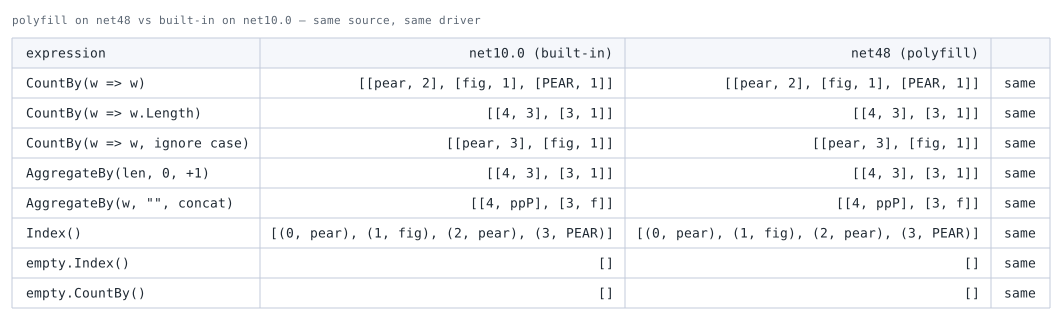
net48 and built for net10.0 where #if switches it to the built-in, run through one and the same driver. Measured with .NET SDK 10.0.302.On this input and this runtime, both sides placed the keys in the order they first appeared, and the output matches down to that ordering.
That ordering is not an API guarantee, however.
CountBy and AggregateBy both return their results by enumerating a Dictionary<TKey, TValue>, so the enumeration order is implementation-defined.
Sort explicitly at the call site if the order carries meaning.
The class is active only when the NET9_0_OR_GREATER symbol is undefined — that is, on any environment below .NET 9, including .NET Framework.
The seed form of AggregateBy is expressed as a seedSelector that ignores the key (key => seed) and delegates to the shared accumulation body.
Behavior of Each Method
CountBy: Element Count per Key
CountBy counts elements per key returned by the key selector, yielding a sequence of KeyValuePair<TKey, int>.
var words = new[] { "apple", "banana", "apple", "cherry", "banana", "apple" };

foreach (var pair in words.CountBy(word => word))
{
    Console.WriteLine($"{pair.Key}: {pair.Value}");
}
// apple: 3
// banana: 2
// cherry: 1
The enumeration order of the results is not guaranteed.
The internal Dictionary<TKey, TValue> has no ordering contract, so code must not rely on any particular order (such as first-appearance order).
When a defined order is required, sort the results explicitly or convert them into an order-preserving collection.
The IEqualityComparer<TKey> overload swaps in a different key equality — case-insensitive counting, for example.
AggregateBy: A Per-Key Fold
AggregateBy is the per-key version of Aggregate, folding independently for each key.
The following computes total sales per region.
var sales = new[]
{
    ("Tokyo", 100),
    ("Osaka", 80),
    ("Tokyo", 120),
    ("Osaka", 60),
};

var totals = sales.AggregateBy(
    keySelector: s => s.Item1,
    seed: 0,
    func: (total, s) => total + s.Item2);

foreach (var pair in totals)
{
    Console.WriteLine($"{pair.Key}: {pair.Value}");
}
// Tokyo: 220
// Osaka: 140
To vary the initial value per key, use the overload taking a seedSelector (Func<TKey, TAccumulate>) instead of seed.
Each key then starts its fold from its own initial state.
Index: Indexed Enumeration
Index attaches a zero-based index to each element, yielding (int Index, TSource Item) tuples.
var items = new[] { "a", "b", "c" };

foreach (var (index, item) in items.Index())
{
    Console.WriteLine($"{index}: {item}");
}
// 0: a
// 1: b
// 2: c
The first tuple element is the index, the second the value.
Note the order is reversed from the Select((item, index) => ...) lambda — Index puts the index first.
Lazy Evaluation and Exception Timing
All three methods are lazy; computation runs at foreach / .ToList() time.
The ArgumentNullException for a null source or delegate, however, is thrown immediately at call time.
IEnumerable<int> numbers = null!;

// ArgumentNullException is thrown on this line, before any enumeration
var query = numbers.CountBy(n => n);
When the key selector returns a null key mid-enumeration, the ArgumentNullException fires at the point the internal dictionary is accessed with that key (the TryGetValue call).
This matches the built-in .NET 9 behavior of the internal dictionary rejecting null keys.
Migration Guard
The polyfill is wrapped in #if !NET9_0_OR_GREATER.
CountBy, AggregateBy and Index do not exist before .NET 9, so guarding with !NETCOREAPP or !NET8_0_OR_GREATER would disable the polyfill in a .NET 8 build and break compilation.
The general rule — disable at and above the version that introduced the methods — is laid out in the .NET 6 backport article.
Caveats
- Results are lazy sequences and re-aggregate on every enumeration: the return value is not a
Dictionarybut a deferred sequence. Materialize with.ToList()or.ToDictionary()when the result is used more than once; otherwise each enumeration re-walks and re-aggregates the source. - Key types are
notnull: the polyfill carries the built-inwhere TKey : notnullconstraint, and a runtimenullkey throwsArgumentNullExceptionat enumeration. To aggregate data withnullkeys, map them first (e.g.?? "(none)"). CountByoverflow: counting useschecked(count + 1), so a key whose count exceedsint.MaxValuethrowsOverflowException. The built-in .NET 9 also adds withchecked, so behavior matches.Indextuple order / naming confusion: the tuple is(Index, Item)— index first. The method nameIndexalso resembles the C# 8System.Indextype, but one is a type and the other a method; they do not collide.
Alternatives / Comparison
| Approach | Pros | Cons | Best for |
|---|---|---|---|
| Dictionary-backed polyfill (this article) | Same memory profile and exception behavior as the built-ins | Somewhat longer implementation | Keeping behavior identical across migration |
| GroupBy-delegating polyfill | A few lines of code | Allocates intermediate groupings; null-key behavior differs from the built-ins |
Temporary use with the differences understood |
Write GroupBy(...).Select(...) inline |
No extra code | Verbose; mass replacement at migration | Few call sites and no migration planned |
| Upgrade to .NET 9 | Root fix plus the allocation savings | Migration cost | When migration is feasible |
Summary
What a CountBy / AggregateBy backport is judged on is not “returning the same result” but “returning it the same way.”
Delegating to GroupBy produces identical values while diverging from the built-ins on two counts: intermediate-grouping allocations and tolerance of null keys.
Direct dictionary accumulation aligns the memory profile, the exception behavior and the where TKey : notnull constraint with the built-ins, making the zero-edit switchover under #if !NET9_0_OR_GREATER genuinely safe.
| Method | Implementation | State held |
|---|---|---|
CountBy |
Direct dictionary accumulation | Count per key only |
AggregateBy |
Direct dictionary accumulation | Accumulator per key only |
Index |
Delegation to Select |
None (pass-through) |
For codebases that routinely aggregate large data sets by key on .NET Framework, adopting this polyfill both cuts allocations today and prepares the migration path.
Related Articles
- Designing LINQ Polyfills That Preserve Lazy Evaluation — Implementing Append, Prepend, TakeLast and SkipLast
- Replacing GroupBy and Full-Sort Workarounds — Implementing Chunk, MaxBy, MinBy and DistinctBy
- Order and OrderDescending by Pure Delegation — A Minimal Polyfill with IOrderedEnumerable Compatibility
- Selector-Free ToDictionary — Designing for Overload Resolution and the notnull Constraint
- Expressing SQL Outer Joins in LINQ — Implementing LeftJoin, RightJoin and Shuffle