Overview
OrderByDescending(x => x.Price).First() and GroupBy(x => x.Key).Select(g => g.First()) appear over and over in real .NET Framework codebases.
They are workaround idioms for “element with the maximum key” and “distinct by key” — and their runtime cost is out of proportion to what they compute.
The code sorts the entire sequence to fetch one element, and builds per-key element lists just to discard everything but the first.
.NET 6 added Chunk, MaxBy, MinBy and DistinctBy as dedicated operators that eliminate both the verbosity and the cost of these idioms.
This article measures what each workaround actually pays, then implements polyfills that bring the same improvement to .NET Framework.
It also covers the version-specific migration guard that first becomes necessary with this batch of methods.
Prerequisites / Environment
- Frameworks: .NET Framework 4.8 (backport target) / .NET 6+ (future migration target)
- APIs: LINQ
Chunk,MaxBy,MinBy,DistinctBy - Approach: apply
#nullable enable; disable automatically on migration via#if !NET6_0_OR_GREATER - Language version: beyond
#nullable enableandusing var(C# 8.0), the implementation uses theTSource?return type ofMaxBy/MinBy(a nullable annotation on an unconstrained type parameter), which requires C# 9.0 or later. The .NET Framework 4.8 default is C# 7.3, so setLangVersionto9.0or later in the.csproj - Verification environment: .NET 10 / Windows 11
The polyfill implementation in this article was built and run for both net48 and net10.0 in the environment above, and the outputs were compared.
On net10.0 the migration #if guard disables the polyfill, so the BCL implementation is used.
The following points were confirmed in that environment:
Chunkproduces the same result on both targets whether the count divides evenly, leaves a remainder, uses asizelarger thansource, or uses an invalidsize.- What
MaxBy/MinByreturn for an empty sequence differs between a non-nullable value type such asintand a reference type. - The elements
DistinctBykeeps, and their order, match on both targets.
Problem: What the Workaround Idioms Cost
The following methods added in .NET 6 are unavailable on .NET Framework.
| Method | Added in | Description |
|---|---|---|
Chunk<T> |
.NET 6.0 | Splits a sequence into chunks of at most the given size |
MaxBy<T, TKey> |
.NET 6.0 | Returns the element whose key is the maximum |
MinBy<T, TKey> |
.NET 6.0 | Returns the element whose key is the minimum |
DistinctBy<T, TKey> |
.NET 6.0 | Filters elements by key uniqueness |
Producing the same results without them requires workaround idioms.
| Goal | Workaround idiom | Runtime cost |
|---|---|---|
| Split into chunks | Indexed Select + GroupBy(t => t.i / size) |
Groups all elements on first enumeration, plus intermediate tuples |
| Max/min by key | OrderByDescending(x => x.Key).First() |
Full $O(n \log n)$ sort |
| Distinct by key | GroupBy(x => x.Key).Select(g => g.First()) |
Full per-key element lists |
The problem is not only verbosity.
It is the entrenched mismatch between goal and cost: paying for a full sort when one element is needed, and keeping every element of a group whose head is the only element used.
Root Cause / Background
After feature development for .NET Framework 4.8 ended, LINQ changes through .NET 5 centered on internal performance work, with few new operators.
.NET 6 was the first release to ship this batch — Chunk, MaxBy, MinBy, DistinctBy — and none of them exist in .NET 5 or earlier.
MaxBy, MinBy and DistinctBy operate by key, while Chunk splits elements by size; the criteria differ, but all four previously required composing several methods.
The fact that they are missing from .NET 5 as well directly drives the migration-guard symbol choice discussed later.
Solution
The extension methods are defined in the original System.Linq namespace so existing code picks them up transparently.
The namespace strategy and the validation/iterator split are justified in the series foundation article; this article focuses on what is specific to these four methods.
Two points are specific here.
First, the four methods split into two evaluation strategies — lazy (Chunk, DistinctBy) and eager (MaxBy, MinBy) — and the method structure must follow each.
Second, the migration guard must be !NET6_0_OR_GREATER, not !NETCOREAPP.
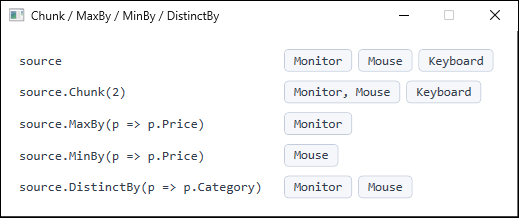
Chunk returns the sequence split into groups; MaxBy and MinBy return a single element, and DistinctBy keeps only the first element per key. These differences in return shape mirror the evaluation strategies discussed later.Implementation
The following is the complete polyfill for all four methods.
Add it to the project as, for example, LinqExtensions.Net6.cs.
#nullable enable

using System;
using System.Collections.Generic;

#if !NET6_0_OR_GREATER // Active only below .NET 6.0 (e.g. .NET Framework)

namespace System.Linq
{
    /// <summary>
    /// Provides extension methods that backfill LINQ methods introduced in .NET 6.0 for older target frameworks.
    /// </summary>
    public static partial class LinqExtensions
    {
        // ==========================================
        // 1. Chunk
        // ==========================================
        public static IEnumerable<TSource[]> Chunk<TSource>(this IEnumerable<TSource> source, int size)
        {
            if (source == null) throw new ArgumentNullException(nameof(source));
            if (size <= 0) throw new ArgumentOutOfRangeException(nameof(size), "Size must be greater than 0.");

            return ChunkIterator(source, size);
        }

        private static IEnumerable<TSource[]> ChunkIterator<TSource>(IEnumerable<TSource> source, int size)
        {
            using var enumerator = source.GetEnumerator();
            while (enumerator.MoveNext())
            {
                var chunk = new TSource[size];
                chunk[0] = enumerator.Current;
                int count = 1;

                while (count < size && enumerator.MoveNext())
                {
                    chunk[count++] = enumerator.Current;
                }

                if (count < size)
                {
                    Array.Resize(ref chunk, count);
                }

                yield return chunk;
            }
        }

        // ==========================================
        // 2. MaxBy
        // ==========================================
        public static TSource? MaxBy<TSource, TKey>(this IEnumerable<TSource> source, Func<TSource, TKey> keySelector)
        {
            if (source == null) throw new ArgumentNullException(nameof(source));
            if (keySelector == null) throw new ArgumentNullException(nameof(keySelector));

            return MaxBy(source, keySelector, comparer: null);
        }

        public static TSource? MaxBy<TSource, TKey>(this IEnumerable<TSource> source, Func<TSource, TKey> keySelector, IComparer<TKey>? comparer)
        {
            if (source == null) throw new ArgumentNullException(nameof(source));
            if (keySelector == null) throw new ArgumentNullException(nameof(keySelector));

            comparer ??= Comparer<TKey>.Default;

            using var enumerator = source.GetEnumerator();
            if (!enumerator.MoveNext())
            {
                // Reference / nullable value types return default (null); only non-nullable value types throw (matches .NET 6)
                if (default(TSource) is null) return default;
                throw new InvalidOperationException("Sequence contains no elements.");
            }

            var maxElement = enumerator.Current;
            var maxKey = keySelector(maxElement);

            while (enumerator.MoveNext())
            {
                var currentElement = enumerator.Current;
                var currentKey = keySelector(currentElement);

                if (comparer.Compare(currentKey, maxKey) > 0)
                {
                    maxElement = currentElement;
                    maxKey = currentKey;
                }
            }

            return maxElement;
        }

        // ==========================================
        // 3. MinBy
        // ==========================================
        public static TSource? MinBy<TSource, TKey>(this IEnumerable<TSource> source, Func<TSource, TKey> keySelector)
        {
            if (source == null) throw new ArgumentNullException(nameof(source));
            if (keySelector == null) throw new ArgumentNullException(nameof(keySelector));

            return MinBy(source, keySelector, comparer: null);
        }

        public static TSource? MinBy<TSource, TKey>(this IEnumerable<TSource> source, Func<TSource, TKey> keySelector, IComparer<TKey>? comparer)
        {
            if (source == null) throw new ArgumentNullException(nameof(source));
            if (keySelector == null) throw new ArgumentNullException(nameof(keySelector));

            comparer ??= Comparer<TKey>.Default;

            using var enumerator = source.GetEnumerator();
            if (!enumerator.MoveNext())
            {
                // Reference / nullable value types return default (null); only non-nullable value types throw (matches .NET 6)
                if (default(TSource) is null) return default;
                throw new InvalidOperationException("Sequence contains no elements.");
            }

            var minElement = enumerator.Current;
            var minKey = keySelector(minElement);

            while (enumerator.MoveNext())
            {
                var currentElement = enumerator.Current;
                var currentKey = keySelector(currentElement);

                if (comparer.Compare(currentKey, minKey) < 0)
                {
                    minElement = currentElement;
                    minKey = currentKey;
                }
            }

            return minElement;
        }

        // ==========================================
        // 4. DistinctBy
        // ==========================================
        public static IEnumerable<TSource> DistinctBy<TSource, TKey>(this IEnumerable<TSource> source, Func<TSource, TKey> keySelector)
        {
            if (source == null) throw new ArgumentNullException(nameof(source));
            if (keySelector == null) throw new ArgumentNullException(nameof(keySelector));

            return DistinctByIterator(source, keySelector, comparer: null);
        }

        public static IEnumerable<TSource> DistinctBy<TSource, TKey>(this IEnumerable<TSource> source, Func<TSource, TKey> keySelector, IEqualityComparer<TKey>? comparer)
        {
            if (source == null) throw new ArgumentNullException(nameof(source));
            if (keySelector == null) throw new ArgumentNullException(nameof(keySelector));

            return DistinctByIterator(source, keySelector, comparer);
        }

        private static IEnumerable<TSource> DistinctByIterator<TSource, TKey>(IEnumerable<TSource> source, Func<TSource, TKey> keySelector, IEqualityComparer<TKey>? comparer)
        {
            var knownKeys = new HashSet<TKey>(comparer);
            foreach (var item in source)
            {
                if (knownKeys.Add(keySelector(item)))
                {
                    yield return item;
                }
            }
        }
    }
}

#endif
Whether this implementation returns what the standard LINQ returns can be checked by building the same calling code for net48 (polyfill active) and for net10.0 (built-in active), running both, and comparing the output.
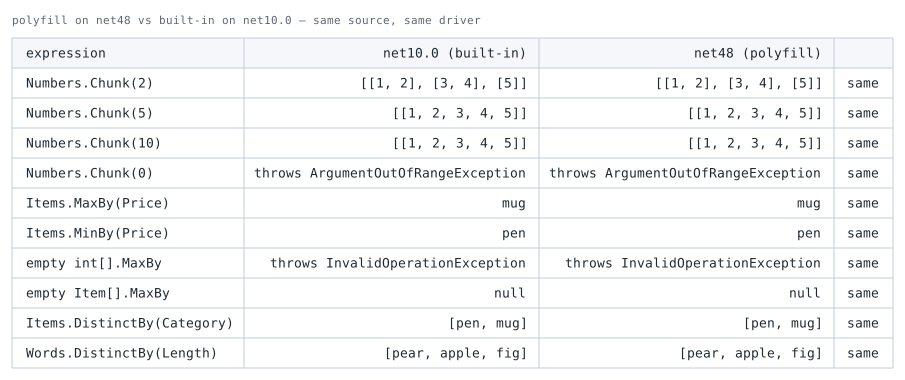
net48 and built for net10.0 where #if switches it to the built-in, run through one and the same driver. Measured with .NET SDK 10.0.302.The two sides agree even on MaxBy over an empty sequence, which throws InvalidOperationException for a value type and returns null for a reference type. That difference is not readable from the signature.
The class is active only when the NET6_0_OR_GREATER symbol is undefined — that is, on any environment below .NET 6, including .NET Framework.
What Each Replacement Buys
MaxBy / MinBy: From Full Sort to Single Pass
The OrderByDescending(...).First() idiom sorts everything to fetch one element.
var products = new[]
{
    new { Name = "A", Price = 300 },
    new { Name = "B", Price = 100 },
    new { Name = "C", Price = 200 },
};

// Workaround: O(n log n) full sort
var before = products.OrderByDescending(p => p.Price).First();

// MaxBy: O(n) single pass
var after = products.MaxBy(p => p.Price);
// after: { Name = "A", Price = 300 }
Internally, the polyfill walks the sequence once, tracking the current maximum key and its element.
var maxElement = enumerator.Current;
var maxKey = keySelector(maxElement);

while (enumerator.MoveNext())
{
    var currentElement = enumerator.Current;
    var currentKey = keySelector(currentElement);

    if (comparer.Compare(currentKey, maxKey) > 0) // Does the current key beat the maximum?
    {
        maxElement = currentElement;
        maxKey = currentKey;
    }
}

return maxElement;
Removing the sort drops the complexity from $O(n \log n)$ to $O(n)$ and eliminates the sort workspace.
MinBy merely flips the comparison from > 0 to < 0.
Note that where Max() / Min() return the key value itself, MaxBy / MinBy return the original element that carries the key.
DistinctBy: From Group Building to HashSet Checks
The GroupBy(...).Select(g => g.First()) idiom makes every group hold all its elements even though only the head is used.
var products = new[]
{
    new { Name = "A", Category = "Food" },
    new { Name = "B", Category = "Tech" },
    new { Name = "C", Category = "Food" },
};

// Workaround: build per-key element lists, then take each head
var before = products.GroupBy(p => p.Category).Select(g => g.First());

// DistinctBy: stream elements through a seen-key check
var after = products.DistinctBy(p => p.Category);
// after: { Name = "A", Category = "Food" }, { Name = "B", Category = "Tech" }
Internally, the polyfill adds each key to a HashSet<TKey> and yields only the elements whose key was not seen before.
var knownKeys = new HashSet<TKey>(comparer); // O(1) registration and lookup

foreach (var item in source)
{
    if (knownKeys.Add(keySelector(item))) // true when the key is new
    {
        yield return item;
    }
}
Only keys are retained — element bodies are never accumulated (space complexity $O(\text{unique keys})$).
Unlike GroupBy, nothing is read ahead: elements stream out lazily, one at a time, in their original order.
Chunk: From Index Arithmetic to Sequential Slicing
Grouping by index / size allocates intermediate tuples, and GroupBy reads the entire source on first enumeration.
Chunk slices arrays of at most size elements as it enumerates.
var result = new[] { 1, 2, 3, 4, 5 }.Chunk(2);
// result: [1, 2], [3, 4], [5]
Internally, an array of size elements is pre-allocated and filled; only a trailing partial chunk is trimmed with Array.Resize.
var chunk = new TSource[size]; // Pre-allocate size elements
chunk[0] = enumerator.Current;
int count = 1;

while (count < size && enumerator.MoveNext())
{
    chunk[count++] = enumerator.Current;
}

if (count < size)
{
    Array.Resize(ref chunk, count); // Resize only the trailing partial chunk
}

yield return chunk;
Each chunk is built only after the previous one is yielded, so the up-front whole-sequence grouping disappears.
Two Evaluation Strategies, Two Method Shapes
The four methods split into two evaluation strategies, and their structure follows suit.
Lazy methods (Chunk / DistinctBy) are iterators built on yield return and process nothing until enumerated.
Because yield return also defers argument checks, the public method and the ~Iterator method are separated to make exceptions immediate.
The rationale and the failure mode of skipping this split are covered in principle 1 of the foundation article.
Eager methods (MaxBy / MinBy) contain no yield return; they scan the whole sequence at call time and return a single result.
Argument checks also run at call time, so no separation is needed.
Whether the return value is a sequence or a single element determines the evaluation strategy, and the strategy determines the method shape.
That is the order in which to make the structural decision when writing a polyfill.
Migration Guard: The First Case That Needs a Version-Specific Symbol
The #if !NETCOREAPP guard used in the foundation article does not work for this batch.
The NETCOREAPP symbol is also defined on .NET Core and .NET 5, so !NETCOREAPP would disable the polyfill in a .NET 5 build.
Chunk and the other three methods do not exist in .NET 5, so the build breaks at that point.
| Symbol | .NET Framework | .NET 5 | .NET 6+ |
|---|---|---|---|
!NETCOREAPP |
Polyfill active | Polyfill disabled (build error) | Polyfill disabled |
!NET6_0_OR_GREATER |
Polyfill active | Polyfill active | Polyfill disabled |
The correct rule is to disable at and above the version that introduced the methods, which here means #if !NET6_0_OR_GREATER.
Generalized: for methods added in .NET X, guard with #if !NETX_0_OR_GREATER.
The backports for later versions (such as Order in .NET 7) apply the same rule.
Caveats
MaxBy/MinByon an empty sequence: for a reference or nullable value element type, an empty source returnsdefault(null); only a non-nullable value type (such asintor astruct) throwsInvalidOperationException. This matches the .NET 6 built-in behavior (the return type isTSource?). When the element type is a non-nullable value type and the sequence may be empty, wrap the call intry-catchor check for elements beforehand. Note that.Any()enumerates the source, so for a deferred source it causes a second enumeration together with the followingMaxBy/MinBy— incorrect for single-use enumerators or sources with side effects; in that case materialize once with.ToList()before checking and selecting.- Size of the trailing chunk: when the element count is not a multiple of
size, the last chunk is smaller. Caller code that assumes uniform chunk sizes is incorrect. DistinctByandnullkeys:nullkeys compare equal to each other, so only the first element with anullkey is emitted.- Scope of
#nullable enable: the directive at the top of the file enables the annotation context file-wide. Repeating it is harmless even when the project sets<Nullable>enable</Nullable>globally.
Alternatives / Comparison
| Approach | Pros | Cons | Best for |
|---|---|---|---|
| Hand-rolled polyfill (this article) | No dependency; also fixes the complexity problems | Implementation effort | Projects minimizing dependencies |
| Keep the workaround idioms | No extra code | Complexity and allocation waste persists | Data that is always tiny |
| MoreLINQ (NuGet) | Rich, battle-tested method set | Adds an external dependency | Projects needing many extra methods |
| Upgrade to .NET 6 | Root fix plus performance gains | Migration cost | When migration is feasible |
MoreLINQ (NuGet package morelinq) covers Chunk and MaxBy equivalents, but when only these four methods are needed, a dependency-free polyfill is simpler to maintain.
Summary
Whether to keep the workaround idioms or replace them comes down to how much data the code processes and how often.
A few dozen items rendered per screen refresh will not expose the problem; as volume and frequency grow, the cost of full sorts and intermediate group building stops being ignorable.
| Method | Workaround cost | Polyfill cost |
|---|---|---|
MaxBy / MinBy |
$O(n \log n)$ full sort | $O(n)$ single pass |
DistinctBy |
Per-key element lists | Key set only ($O(\text{unique keys})$) |
Chunk |
Up-front whole-sequence grouping | Sequential per-chunk build ($O(size)$) |
The replacement itself is just adding polyfills with the original names and signatures, and the #if !NET6_0_OR_GREATER guard switches to the built-in implementations automatically upon migrating to .NET 6.
Related Articles
- Designing LINQ Polyfills That Preserve Lazy Evaluation — Implementing Append, Prepend, TakeLast and SkipLast
- Order and OrderDescending by Pure Delegation — A Minimal Polyfill with IOrderedEnumerable Compatibility
- Selector-Free ToDictionary — Designing for Overload Resolution and the notnull Constraint
- Key-Based Aggregation Without GroupBy — Dictionary-Backed CountBy, AggregateBy and Index
- Expressing SQL Outer Joins in LINQ — Implementing LeftJoin, RightJoin and Shuffle