Overview
.NET 8 added almost no new operators to LINQ.
Its practical addition is a set of overloads — ToDictionary variants that turn a sequence of KeyValuePair or tuples into a dictionary without selectors.
Backporting this batch is therefore not about a new algorithm but about signature design: fitting new signatures into an existing method family without friction.
This article implements the selector-free ToDictionary polyfill (the KeyValuePair and tuple forms) and breaks its design down into three decisions.
- Avoid colliding with the existing
ToDictionary(keySelector, valueSelector)during overload resolution - Pin the resolution target of internal delegation with the named argument
comparer: - Match the
where TKey : notnullconstraint and the return type so nullable analysis agrees before and after migration
Prerequisites / Environment
- Frameworks: .NET Framework 4.8 (backport target) / .NET 8+ (future migration target)
- APIs: the selector-free
ToDictionaryoverloads — 4 signatures (KeyValuePairand tuple forms, each with anIEqualityComparer<TKey>overload) - Approach: apply
#nullable enable; disable automatically on migration via#if !NET8_0_OR_GREATER - Language version:
#nullable enable, nullable reference annotations, and thewhere TKey : notnullconstraint require C# 8.0 or later. The .NET Framework 4.8 default is C# 7.3, so setLangVersionto8.0or later in the.csproj(take particular care in older non-SDK projects that do not setLangVersionexplicitly) - Verification environment: .NET 10 / Windows 11
The polyfill implementation in this article was built and run for both net48 and net10.0 in the environment above, and the outputs were compared.
On net10.0 the migration #if guard disables the polyfill, so the BCL implementation is used.
The following points were confirmed in that environment:
- The
KeyValuePairand tuple overloads, along with theirIEqualityComparervariants, produce the same results on both targets. - The exception type thrown on a duplicate key matches on both targets.
Problem
The following overloads added in .NET 8 are unavailable on .NET Framework.
| Method | Added in | Description |
|---|---|---|
ToDictionary<TKey, TValue>(this IEnumerable<KeyValuePair<TKey, TValue>>) |
.NET 8.0 | Converts a sequence of KeyValuePair directly into a dictionary |
ToDictionary<TKey, TValue>(this IEnumerable<(TKey, TValue)>) |
.NET 8.0 | Converts a sequence of 2-tuples directly into a dictionary |
Each also has an IEqualityComparer<TKey> overload, for 4 signatures in total.
Without them, even when elements are already key/value pairs, the existing ToDictionary demands explicit identity selectors.
pairs.ToDictionary(p => p.Key, p => p.Value)instead ofpairs.ToDictionary()items.ToDictionary(t => t.Item1, t => t.Item2)for tuple sequences
p => p.Key / p => p.Value are boilerplate unrelated to the conversion itself, and swapping the key and value selectors is an easy mistake to make.
Root Cause / Background
When filtering a Dictionary into a new one, or dictionary-izing tuples returned by Select, the elements are already key/value shaped.
.NET 8 standardized the selector-free overloads to remove the identity selectors that such call sites were forced to write.
Because this is a signature addition to an existing method, the built-in design itself is careful not to disturb resolution of the existing overloads.
A polyfill must be designed under the same constraint — that is the subject of this article.
Solution
The extension methods are defined in the original System.Linq namespace and wrapped in #if !NET8_0_OR_GREATER (see the series foundation article for the rationale behind both).
On top of that, three signature-design points are aligned with the built-in API.
- Restrict the first parameter to
IEnumerable<KeyValuePair<TKey, TValue>>/IEnumerable<(TKey, TValue)>so existing overloads are never contested - Pin internal delegation with the named argument
comparer: - Use
Dictionary<TKey, TValue>as the return type andwhere TKey : notnullas the constraint
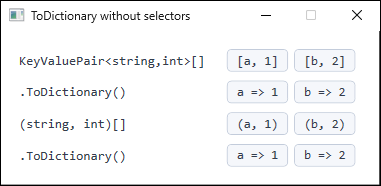
ToDictionary() called without selectors. Both a sequence of KeyValuePair and a sequence of tuples yield the same key-to-value mapping.Implementation
The following is the complete polyfill for all 4 signatures.
For sources implementing ICollection<T>, the dictionary capacity is pre-sized from the element count, avoiding rehashing just as the built-in implementation does.
Add it to the project as, for example, LinqExtensions.Net8.cs.
#nullable enable

using System;
using System.Collections.Generic;

#if !NET8_0_OR_GREATER // Active only below .NET 8.0 (e.g. .NET Framework)

namespace System.Linq
{
    /// <summary>
    /// Provides extension methods that backfill LINQ methods introduced in .NET 8.0 for older target frameworks.
    /// </summary>
    public static partial class LinqExtensions
    {
        // ==========================================
        // 1. IEnumerable<KeyValuePair<TKey, TValue>>.ToDictionary
        // ==========================================
        public static Dictionary<TKey, TValue> ToDictionary<TKey, TValue>(
            this IEnumerable<KeyValuePair<TKey, TValue>> source)
            where TKey : notnull
            => source.ToDictionary(comparer: null); // Named argument pins resolution to the comparer overload

        public static Dictionary<TKey, TValue> ToDictionary<TKey, TValue>(
            this IEnumerable<KeyValuePair<TKey, TValue>> source,
            IEqualityComparer<TKey>? comparer)
            where TKey : notnull
        {
            if (source == null) throw new ArgumentNullException(nameof(source));

            var dictionary = source is ICollection<KeyValuePair<TKey, TValue>> collection
                ? new Dictionary<TKey, TValue>(collection.Count, comparer)
                : new Dictionary<TKey, TValue>(comparer);

            foreach (var pair in source)
            {
                dictionary.Add(pair.Key, pair.Value);
            }

            return dictionary;
        }

        // ==========================================
        // 2. IEnumerable<(TKey, TValue)>.ToDictionary
        // ==========================================
        public static Dictionary<TKey, TValue> ToDictionary<TKey, TValue>(
            this IEnumerable<(TKey Key, TValue Value)> source)
            where TKey : notnull
            => source.ToDictionary(comparer: null);

        public static Dictionary<TKey, TValue> ToDictionary<TKey, TValue>(
            this IEnumerable<(TKey Key, TValue Value)> source,
            IEqualityComparer<TKey>? comparer)
            where TKey : notnull
        {
            if (source == null) throw new ArgumentNullException(nameof(source));

            var dictionary = source is ICollection<(TKey Key, TValue Value)> collection
                ? new Dictionary<TKey, TValue>(collection.Count, comparer)
                : new Dictionary<TKey, TValue>(comparer);

            foreach (var pair in source)
            {
                dictionary.Add(pair.Key, pair.Value);
            }

            return dictionary;
        }
    }
}

#endif
Whether this implementation returns what the standard LINQ returns can be checked by building the same calling code for net48 (polyfill active) and for net10.0 (built-in active), running both, and comparing the output.
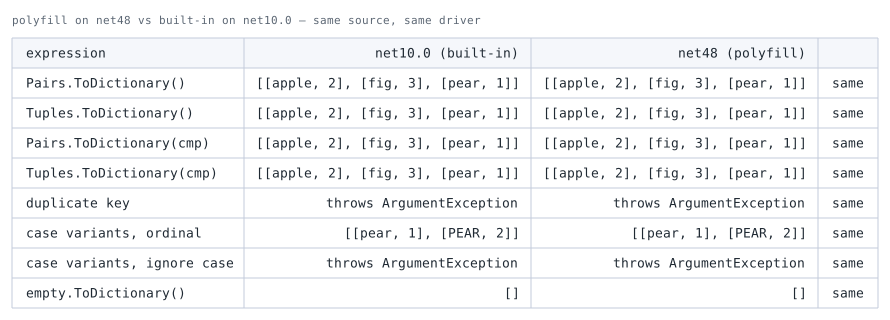
net48 and built for net10.0 where #if switches it to the built-in, run through one and the same driver. Measured with .NET SDK 10.0.302.The two sides agree down to raising ArgumentException on a duplicate key. Passing OrdinalIgnoreCase as the comparer makes keys that differ only in case count as duplicates, producing the same exception.
The class is active only when the NET8_0_OR_GREATER symbol is undefined — that is, on any environment below .NET 8, including .NET Framework.
The Three Signature-Design Decisions
Decision 1: A First Parameter Type That Cannot Collide
The name ToDictionary already exists on .NET Framework, so adding overloads carelessly could disturb resolution.
This polyfill is safe because the first (extended) parameter type partitions the call space.
- Calls that pass selectors (
ToDictionary(x => x.Id)and friends) resolve to the existing built-in overloads that takeFunc<...>parameters - Only selector-free calls on
KeyValuePairor tuple sequences resolve to the polyfill
For any polyfill that adds signatures to an existing method, the first thing to verify is that the new signatures match none of the existing call shapes.
If that property does not hold, code may compile while silently binding to an unintended overload.
Decision 2: Pinning Resolution with the Named Argument comparer:
The parameterless overloads delegate to the comparer overloads by passing null.
Writing that plainly as source.ToDictionary(null) is ambiguous: the null literal converts both to IEqualityComparer<TKey> and to Func<...>, leaving the compiler multiple candidates.
public static Dictionary<TKey, TValue> ToDictionary<TKey, TValue>(
    this IEnumerable<KeyValuePair<TKey, TValue>> source)
    where TKey : notnull
    => source.ToDictionary(comparer: null); // Named argument pins the comparer overload
With the named argument comparer:, only overloads that have a parameter of that name remain candidates, making the resolution target unique.
This is the standard technique when delegating into a densely overloaded API.
Decision 3: Matching where TKey : notnull and the Return Type
The built-in overloads return Dictionary<TKey, TValue> and constrain where TKey : notnull.
Matching both means that in a #nullable enable codebase, nullable analysis produces identical results before and after migration.
Omitting the constraint still compiles, but then calls with nullable key types that were accepted under the polyfill start producing warnings after moving to .NET 8.
For the automatic switch to the built-in implementation (see below) to be genuinely seamless, signature compatibility matters exactly as much as algorithmic compatibility.
Behavior by Use Case
Converting a Sequence of KeyValuePair
When filtering an existing dictionary into a new one, the elements are already KeyValuePair.
var source = new Dictionary<string, int>
{
    ["apple"] = 3,
    ["banana"] = 5,
    ["cherry"] = 2,
};

// Keep only entries with a value of 3 or more
var filtered = source.Where(pair => pair.Value >= 3)
                     .ToDictionary();
// filtered: { "apple": 3, "banana": 5 }
Dictionary<TKey, TValue> implements IEnumerable<KeyValuePair<TKey, TValue>>, so the result of Where is a KeyValuePair sequence that converts back to a dictionary with no selectors.
Converting a Sequence of 2-Tuples
Tuples returned by Select convert directly as well.
var files = new[] { "report.pdf", "photo.jpg", "notes.txt" };

// File name as key, extension as value
var byName = files.Select(name => (name, System.IO.Path.GetExtension(name)))
                  .ToDictionary();
// byName: { "report.pdf": ".pdf", "photo.jpg": ".jpg", "notes.txt": ".txt" }
The first tuple element becomes the key, the second the value.
Tuple element names (such as (name, ext)) do not affect the type, so the conversion works with or without them.
Specifying an IEqualityComparer<TKey>
The comparer overloads build dictionaries with custom key equality, such as case-insensitive lookups.
var pairs = new[] { ("Alpha", 1), ("BETA", 2) };

var dictionary = pairs.ToDictionary(StringComparer.OrdinalIgnoreCase);

bool found = dictionary.ContainsKey("alpha"); // true
The comparer-free overloads use EqualityComparer<TKey>.Default.
Eager Evaluation
Unlike Where or Order, ToDictionary evaluates eagerly.
It enumerates the source to the end at call time and returns a finished dictionary.
var query = Enumerable.Range(1, 3).Select(n => (n, n * n));

var dictionary = query.ToDictionary(); // The source is enumerated here
// dictionary: { 1: 1, 2: 4, 3: 9 }
Even when the source is a lazy query, the call produces a settled dictionary.
Later changes to the underlying data do not affect the constructed dictionary.
Migration Guard
The polyfill is wrapped in #if !NET8_0_OR_GREATER.
These overloads do not exist before .NET 8, so the wrong guard breaks compilation. !NETCOREAPP disables the polyfill on every target where NETCOREAPP is defined (.NET Core and .NET 5–7), whereas !NET7_0_OR_GREATER disables it only on net7.0 and later (on .NET 6 the NET7_0_OR_GREATER symbol is undefined, so the polyfill stays active; on .NET 7 it is disabled and fails to compile). Both switch the polyfill off where the overloads are missing, so the correct guard is #if !NET8_0_OR_GREATER, disabling it only from the introducing version.
The general rule — disable at and above the version that introduced the methods — is laid out in the .NET 6 backport article.
Caveats
- When to use the existing
ToDictionaryinstead: the new overloads apply only when elements are alreadyKeyValuePairor tuples. For arbitrary element types, keep passing a key selector (and value selector) to the existingToDictionary. - Duplicate keys throw: the implementation uses
Dictionary<TKey, TValue>.Add, so a duplicate key raisesArgumentException, matching the built-in behavior. For last-wins semantics, populate manually withdictionary[key] = value. nullkeys throw: anullkey raisesArgumentNullException. Thewhere TKey : notnullconstraint makes reference-type keys non-null by contract, and runtimenullleakage is caught by this exception.- Eager evaluation: the source is enumerated to the end, so avoid infinite sequences and sources with per-enumeration side effects. The
ArgumentNullExceptionfor anullsource is thrown immediately at call time.
Alternatives / Comparison
| Approach | Pros | Cons | Best for |
|---|---|---|---|
| Hand-rolled polyfill (this article) | No dependency; signatures match the built-ins exactly | Requires overload-design care | #nullable enable codebases heading toward migration |
Write ToDictionary(p => p.Key, p => p.Value) inline |
No extra code | Verbose; mass replacement at migration | Few call sites and no migration planned |
| Upgrade to .NET 8 | Root fix plus language features | Migration cost | When migration is feasible |
Inline selectors cost nothing today, but consolidating to the selector-free spelling after a .NET 8 migration means finding and replacing every call site.
Summary
The .NET 8 selector-free ToDictionary is a new signature, not a new algorithm, and the backport’s quality is decided by signature design.
| Decision | Content |
|---|---|
| Restricted first parameter | KeyValuePair / tuple sequences only — never contests existing overloads |
Named argument comparer: |
Pins internal delegation to the comparer overload |
notnull constraint and return type |
Match the built-ins so nullable analysis agrees across migration |
Use the selector-free overloads only for inputs that are already pairs, and the classic selector-based ToDictionary for everything else.
Under that discipline, the #if !NET8_0_OR_GREATER guard swaps in the built-in implementation at migration time with zero code changes.
Related Articles
- Designing LINQ Polyfills That Preserve Lazy Evaluation — Implementing Append, Prepend, TakeLast and SkipLast
- Replacing GroupBy and Full-Sort Workarounds — Implementing Chunk, MaxBy, MinBy and DistinctBy
- Order and OrderDescending by Pure Delegation — A Minimal Polyfill with IOrderedEnumerable Compatibility
- Key-Based Aggregation Without GroupBy — Dictionary-Backed CountBy, AggregateBy and Index
- Expressing SQL Outer Joins in LINQ — Implementing LeftJoin, RightJoin and Shuffle