Overview
.NET Framework 4.8 continues to ship with Windows, but feature development stopped in 2019, so any LINQ method added since then is unavailable.
The missing methods can be hand-rolled as extension methods (polyfills), yet reproducing the exact feel of standard LINQ takes more than matching signatures.
This article uses the four methods added during the .NET Core 2.0–3.0 era — Append, Prepend, TakeLast and SkipLast — to establish three design principles for writing LINQ polyfills.
- Split argument validation from the iterator body — keep lazy evaluation while making exceptions fire at call time
- Minimize buffering — choose between pass-through and sliding-window algorithms
- Guard migration with conditional compilation — switch to the built-in implementation without touching code
These principles apply beyond the four methods covered here: every backport of the methods added in .NET 6 and later (see the related articles at the end) builds on them.
As the foundation article of the series, this piece explains the rationale behind each principle from first causes.
Prerequisites / Environment
- Frameworks: .NET Framework 4.8 (backport target) / .NET 5+ (future migration target)
- APIs: LINQ
Append,Prepend,TakeLast,SkipLast - Approach: split public methods from iterators; disable automatically on migration via
#if !NETCOREAPP - Verification environment: .NET 10 / Windows 11
The polyfill implementation in this article was built and run for both net48 and net10.0 in the environment above, and the outputs were compared.
On net10.0 the migration #if guard disables the polyfill, so the BCL implementation is used.
The following points were confirmed in that environment:
AppendandPrependare present in the BCL from .NET Framework 4.7.1 onward, so adding the polyfill causes a conflict.- Passing 0, a value larger than the element count, or a negative value to
TakeLast/SkipLastproduces the same result on both targets. TakeLaston an empty sequence also produces the same result on both targets.NET471_OR_GREATERrelies on the implicit definitions of the SDK-style project. With those definitions turned off, and in legacy-format projects, the same source fails withCS0121; declaring it throughDefineConstantsmakes it compile.
Why the Polyfill Lives in the System.Linq Namespace
The hand-rolled extension methods are deliberately defined in the same System.Linq namespace as the originals.
Existing source files already contain using System.Linq;, so no additional using directive is needed and the missing methods become available without changing a single line of calling code.
This placement works in tandem with the migration guard described later (principle 3): when the project is eventually upgraded, the built-in implementation takes over without any edits at call sites.
Had the methods lived in a custom namespace, migration would require hunting down and deleting every using directive and call site, and the transparent switch would not hold.
The Four Operators Added During the .NET Core Era
Between .NET Framework 4.8 and .NET 5 (.NET Core 2.0–3.1), LINQ development focused on rewriting internals for performance rather than adding operators.
The additions from that window include ToHashSet (.NET Core 2.0) among others, but the four this article uses as its subject are the following.
| Method | Added in | Description |
|---|---|---|
Append<T> |
.NET Core 2.0 | Appends one element to the end of a sequence |
Prepend<T> |
.NET Core 2.0 | Prepends one element to the beginning of a sequence |
TakeLast<T> |
.NET Core 3.0 | Returns the last N elements of a sequence |
SkipLast<T> |
.NET Core 3.0 | Returns all elements except the last N |
Whether these four exist in the .NET Framework BCL is settled by compiling against each target framework in turn.
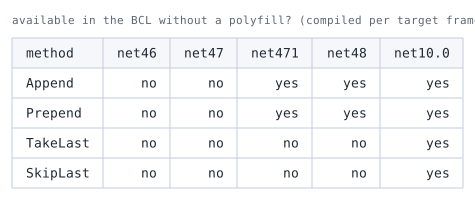
yes means the method exists in the BCL of that TFM. Measured with .NET SDK 10.0.302.Append and Prepend are available from .NET Framework 4.7.1 onward, because 4.7.1 is the version that implements .NET Standard 2.0, which includes both.
Defining them unconditionally as a polyfill while targeting 4.8 therefore collides with the BCL definitions and fails to compile with CS0121 (ambiguous call).
The implementation below guards those two with an extra #if !NET471_OR_GREATER.
That guard only works while the SDK’s implicit defines are in effect, though. NET471_OR_GREATER is a symbol an SDK-style project defines implicitly from TargetFramework, and a legacy-format project — one specifying TargetFrameworkVersion — does not define it.
The figure below builds the same source in several configurations.

namespace System.Linq as the article does, with a call to Append, built in four configurations. The symbol column is not inferred from whether the build succeeded: it comes from which branch of a #warning placed in the source fired.In the legacy format NET471_OR_GREATER is undefined, so the guard always holds, the polyfill is compiled in, and it collides with the BCL Append as CS0121.
As the second row shows, an SDK-style project reaches the same result once DisableImplicitFrameworkDefines switches the implicit defines off.
What the symbol depends on is the SDK’s implicit definition, not the project format as such.
A legacy-format project has to define the symbol itself.
<PropertyGroup>
  <DefineConstants>$(DefineConstants);NET471_OR_GREATER</DefineConstants>
</PropertyGroup>
The fourth row of the table adds exactly that, and lands on the same result as the SDK-style project.
That definition belongs only in a project targeting .NET Framework 4.7.1 or later, though.
Defining it while targeting 4.7 or earlier switches the polyfill off where the BCL has no Append / Prepend either, and the call then fails to resolve.
TakeLast and SkipLast, by contrast, exist in no version of .NET Framework. Those are the ones that need a polyfill.
Without them, .NET Framework code keeps resorting to workarounds: allocating an array for Concat(new[] { element }) instead of Append, or counting the sequence first and subtracting to simulate TakeLast.
Both obscure intent and invite unnecessary allocations or double enumeration.
Note that methods such as Chunk and MaxBy arrived in .NET 6, not in this window.
Their implementation is covered in a separate article.
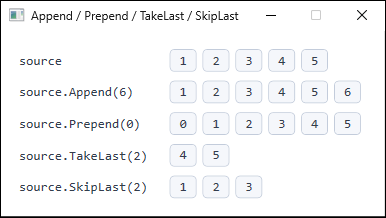
1..5. Unlike Append and Prepend, which only add one element, the tail-oriented TakeLast and SkipLast have to reason about how far enumeration has progressed in order to know the end.Implementation
The following code makes all four methods available in a .NET Framework project with the same call syntax as the originals.
Copy it into a file such as LinqExtensions.Net5.cs.
using System;
using System.Collections.Generic;

#if !NETCOREAPP // Active only outside .NET Core / .NET 5+ (e.g. .NET Framework)

namespace System.Linq
{
    /// <summary>
    /// Backports .NET 5-equivalent LINQ methods to .NET Framework environments.
    /// </summary>
    public static partial class LinqExtensions
    {
        // Append and Prepend exist in the BCL from .NET Framework 4.7.1 onward.
        // Defining them unconditionally causes CS0121 (ambiguous call), so guard them further.
#if !NET471_OR_GREATER

        // ==========================================
        // 1. Append
        // ==========================================
        public static IEnumerable<TSource> Append<TSource>(this IEnumerable<TSource> source, TSource element)
        {
            if (source == null) throw new ArgumentNullException(nameof(source));
            return AppendIterator(source, element);
        }

        private static IEnumerable<TSource> AppendIterator<TSource>(IEnumerable<TSource> source, TSource element)
        {
            foreach (var item in source)
            {
                yield return item;
            }
            yield return element;
        }

        // ==========================================
        // 2. Prepend
        // ==========================================
        public static IEnumerable<TSource> Prepend<TSource>(this IEnumerable<TSource> source, TSource element)
        {
            if (source == null) throw new ArgumentNullException(nameof(source));
            return PrependIterator(source, element);
        }

        private static IEnumerable<TSource> PrependIterator<TSource>(IEnumerable<TSource> source, TSource element)
        {
            yield return element;
            foreach (var item in source)
            {
                yield return item;
            }
        }

#endif

        // ==========================================
        // 3. TakeLast
        // ==========================================
        public static IEnumerable<TSource> TakeLast<TSource>(this IEnumerable<TSource> source, int count)
        {
            if (source == null) throw new ArgumentNullException(nameof(source));
            if (count <= 0) return Enumerable.Empty<TSource>();

            return TakeLastIterator(source, count);
        }

        private static IEnumerable<TSource> TakeLastIterator<TSource>(IEnumerable<TSource> source, int count)
        {
            var queue = new Queue<TSource>(count);
            foreach (var item in source)
            {
                if (queue.Count == count)
                {
                    queue.Dequeue();
                }
                queue.Enqueue(item);
            }

            foreach (var item in queue)
            {
                yield return item;
            }
        }

        // ==========================================
        // 4. SkipLast
        // ==========================================
        public static IEnumerable<TSource> SkipLast<TSource>(this IEnumerable<TSource> source, int count)
        {
            if (source == null) throw new ArgumentNullException(nameof(source));
            if (count <= 0) return source;

            return SkipLastIterator(source, count);
        }

        private static IEnumerable<TSource> SkipLastIterator<TSource>(IEnumerable<TSource> source, int count)
        {
            var queue = new Queue<TSource>(count);
            foreach (var item in source)
            {
                if (queue.Count == count)
                {
                    yield return queue.Dequeue();
                }
                queue.Enqueue(item);
            }
        }
    }
}

#endif
Two structural traits carry the design principles explained below: every method is split into a validating public method and a private iterator containing yield return, and TakeLast / SkipLast are built on a Queue<T>.
Whether this implementation returns what the standard LINQ returns can be checked by building the same calling code for net48 (polyfill active) and for net10.0 (built-in active), running both, and comparing the output.
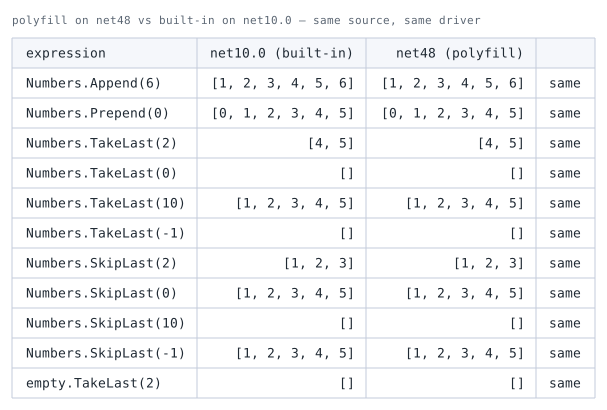
net48 and built for net10.0 where #if switches it to the built-in, run through one and the same driver. The boundary cases — 0, a count past the end, a negative count, and an empty sequence — agree as well. Measured with .NET SDK 10.0.302.Principle 1: Split Argument Validation from the Iterator
Merging the public method and the private ~Iterator method into one looks simpler.
The split exists because of how lazy evaluation changes the timing of exceptions in C#.
The Special Behavior of yield return
A method containing yield return (an iterator block) executes none of its body at call time.
The code only starts running when the data is actually needed — when the result is iterated with foreach or materialized with .ToList().
Combining the argument check and the loop in one method causes the following problem.
// Anti-pattern: validation and iteration in one method
public static IEnumerable<TSource> Append<TSource>(this IEnumerable<TSource> source, TSource element)
{
    if (source == null) throw new ArgumentNullException(nameof(source)); // (1)

    foreach (var item in source)
    {
        yield return item;
    }
    yield return element;
}
Calling this implementation with null behaves as follows.
IEnumerable<int> numbers = null;

var result = numbers.Append(5); // No error here

Console.WriteLine("Subsequent logic runs...");

foreach (var item in result) // ArgumentNullException is finally thrown here
At the call site, even the null check at (1) never runs.
The crash happens much later, at the foreach.
The root cause (passing null) sits several lines earlier — possibly in another class — while the exception surfaces at a seemingly unrelated loop, making diagnosis difficult.
Immediate Validation Through Separation
A regular method without yield return executes immediately when called.
Placing the argument checks in a regular method and delegating to the iterator afterwards keeps the benefits of lazy evaluation while raising exceptions right at the source of the bug.
Standard LINQ uses this two-stage pattern consistently, and a polyfill must follow it to reproduce the same exception timing as the originals.
Principle 2: Minimize Buffering
All four methods accept IEnumerable<T>, so the algorithm must work under the constraint that the sequence length is unknown until fully enumerated.
Two strategies emerge.
Pass-Through: Append and Prepend
Append streams the source through unchanged and emits the extra element once the source is exhausted.
foreach (var item in source)
{
    yield return item; // Pass the original data through
}
yield return element; // Emit the appended element at the end
Prepend is the mirror image: emit the new element first, then follow with the source.
yield return element; // Emit the prepended element first

foreach (var item in source)
{
    yield return item; // Then pass the original data through
}
Neither stores anything, so space complexity is $O(1)$.
Compared with the Concat(new[] { element }) workaround, no array is allocated for a single element.
var appended = new[] { 1, 2, 3 }.Append(4);   // 1, 2, 3, 4
var prepended = new[] { 1, 2, 3 }.Prepend(0); // 0, 1, 2, 3
Sliding Window: TakeLast and SkipLast
The two tail-based methods cannot be implemented as pass-throughs.
Whether the current element belongs to the last N cannot be decided until later elements arrive.
Both therefore use a Queue<T> as a sliding window holding only the most recent count elements.
TakeLast keeps updating the queue, evicting the oldest element when full; whatever remains after the source ends is exactly the last N.
var queue = new Queue<TSource>(count);

foreach (var item in source)
{
    if (queue.Count == count)
    {
        queue.Dequeue(); // Push out the oldest element
    }
    queue.Enqueue(item);
}

foreach (var item in queue)
{
    yield return item; // What remains is the last N elements
}
SkipLast runs the same window in reverse.
When the queue is full and a new element arrives, the evicted front element is guaranteed not to be among the last N — so that is the moment to emit it.
var queue = new Queue<TSource>(count);

foreach (var item in source)
{
    if (queue.Count == count)
    {
        yield return queue.Dequeue(); // Confirmed not among the last N — emit it
    }
    queue.Enqueue(item);
}
// The last N elements left in the queue are never emitted (= skipped)
The output always trails the input by count elements — that is the crux.
Regardless of the source size, only count elements are held at any time, keeping space complexity at $O(count)$.
The double enumeration of the Count()-then-Skip/Take workaround also disappears.
var taken = new[] { 1, 2, 3, 4, 5 }.TakeLast(3);   // 3, 4, 5
var skipped = new[] { 1, 2, 3, 4, 5 }.SkipLast(2); // 1, 2, 3
Principle 3: Guard Migration with Conditional Compilation
Leaving hand-rolled methods in System.Linq and then upgrading the project to .NET 5 or later produces the compile error “The call is ambiguous (CS0121)” because the built-in methods now collide with the polyfill.
The conditional compilation wrapper around the file prevents this.
#if !NETCOREAPP
namespace System.Linq
{
    // Extension method implementations...
}
#endif
The compiler defines the NETCOREAPP symbol automatically when building for .NET Core or .NET 5+.
| Build environment | Result of #if !NETCOREAPP |
Behavior |
|---|---|---|
| .NET Framework | Condition holds | The polyfill compiles and fills the gap |
| .NET 5 / .NET 6+ | Condition fails | The file is treated as empty; built-in LINQ is used |
When the framework is upgraded, the switch to the built-in implementation happens automatically — no file deletion, no code edits.
This is the migration guard that pairs with the namespace strategy described earlier.
Note that !NETCOREAPP is only correct because the methods here were added in .NET Core 2.0–3.0.
Guarding methods added in .NET 6 or later with this condition would disable the polyfill on .NET 5 and break the build.
The choice of version-specific symbols (NET6_0_OR_GREATER and friends) is covered in the .NET 6 backport article.
Caveats
TakeLast/SkipLastconsume memory proportional tocount: the sliding window is frugal, but a hugecountstill allocates a buffer of that size. The approach brings no benefit when the window effectively spans the whole sequence.- Behavior for
count <= 0:TakeLastreturns an empty sequence andSkipLastreturns the source itself. No exception is thrown, matching the built-in behavior. - Re-execution on every enumeration: all four methods are lazy, so enumerating the same query twice walks the source twice. Materialize with
.ToList()when the result is reused. - Performance optimizations are simpler than the originals: the built-in implementations special-case
IList<T>sources and more. This polyfill is generic-only; results and exceptions match, but certain collection types may run slower than on modern .NET.
Summary
Using Append, Prepend, TakeLast and SkipLast as the subject, this article established three design principles for LINQ polyfills.
| Principle | Purpose |
|---|---|
| Split validation from the iterator | Keep lazy evaluation while throwing at call time |
| Minimize buffering | $O(1)$ for pass-through, $O(count)$ for tail-based operations |
| Guard migration with conditional compilation | Switch to built-in LINQ on upgrade without code changes |
| Method | Space complexity | Algorithm |
|---|---|---|
Append / Prepend |
$O(1)$ | Pass-through |
TakeLast / SkipLast |
$O(count)$ | Sliding window over a Queue<T> |
If these four methods are all that is missing, a hand-rolled polyfill avoids adding an external dependency.
When methods from .NET 6 and later are also needed, the same principles carry over with version-specific guards layered on top (see the related articles).
Related Articles
- Replacing GroupBy and Full-Sort Workarounds — Implementing Chunk, MaxBy, MinBy and DistinctBy
- Order and OrderDescending by Pure Delegation — A Minimal Polyfill with IOrderedEnumerable Compatibility
- Selector-Free ToDictionary — Designing for Overload Resolution and the notnull Constraint
- Key-Based Aggregation Without GroupBy — Dictionary-Backed CountBy, AggregateBy and Index
- Expressing SQL Outer Joins in LINQ — Implementing LeftJoin, RightJoin and Shuffle