Overview
The polyfill for Order and OrderDescending, added in .NET 7, needs only one line of body per method.
No iterator, no Queue<T> — each method simply delegates to the existing OrderBy / OrderByDescending with an identity lambda.
Precisely because the implementation is trivial, what decides the quality of this polyfill is not the algorithm but compatibility details.
This article presents the delegation-based implementation and then examines the two questions that determine compatibility.
- Returning anything other than
IOrderedEnumerable<T>breaksThenBychaining and diverges from the original API - The exception thrown for types with no default ordering differs between .NET Framework and .NET Core-based runtimes
A polyfill built purely on delegation to existing APIs is the counterpart to the hand-written iterator style (see the foundation article), and this article doubles as the reference example for that pattern.
Prerequisites / Environment
- Frameworks: .NET Framework 4.8 (backport target) / .NET 7+ (future migration target)
- APIs: LINQ
Order/OrderDescending(4 signatures, including theIComparer<T>overloads) - Approach: apply
#nullable enable; disable automatically on migration via#if !NET7_0_OR_GREATER - Language version:
#nullable enableand nullable reference annotations require C# 8.0 or later. The .NET Framework 4.8 default is C# 7.3, so setLangVersionto8.0or later in the.csproj(dropping#nullable enableand the?annotations allows C# 7.3) - Verification environment: .NET 10 / Windows 11
The polyfill implementation in this article was built and run for both net48 and net10.0 in the environment above, and the outputs were compared.
On net10.0 the migration #if guard disables the polyfill, so the BCL implementation is used.
The following points were confirmed in that environment:
- The return value is an
IOrderedEnumerable, soThenBycan be chained onto it. - Elements that compare equal keep their relative order (a stable sort).
The Identity-Lambda Boilerplate
Order / OrderDescending sort a sequence by the elements themselves.
| Method | Added in | Description |
|---|---|---|
Order<T> |
.NET 7.0 | Sorts a sequence ascending by the elements themselves |
OrderDescending<T> |
.NET 7.0 | Sorts a sequence descending by the elements themselves |
Without them, .NET Framework code keeps writing OrderBy(x => x) / OrderByDescending(x => x) even when sorting by the value itself.
The x => x is boilerplate unrelated to the sorting intent and a common site for minor mistakes such as grabbing the wrong key selector.
A dedicated method with the identity function baked in removes that noise, and .NET 7 standardized exactly that.
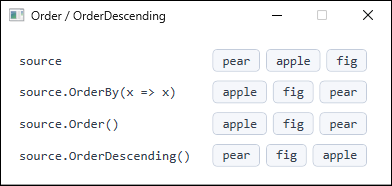
Order() produces the same ordering as OrderBy(x => x). That equivalence is what makes a delegating implementation that simply passes the identity lambda match the built-in behavior.Implementation by Delegation
The following is the complete polyfill for all four signatures.
Each method just passes an identity lambda to OrderBy / OrderByDescending, so sort stability and culture-sensitive comparison behavior are identical to the originals.
Add it to the project as, for example, LinqExtensions.Net7.cs.
#nullable enable

using System;
using System.Collections.Generic;

#if !NET7_0_OR_GREATER // Active only below .NET 7.0 (e.g. .NET Framework)

namespace System.Linq
{
    /// <summary>
    /// Provides extension methods that backfill LINQ methods introduced in .NET 7.0 for older target frameworks.
    /// </summary>
    public static partial class LinqExtensions
    {
        // ==========================================
        // 1. Order
        // ==========================================
        public static IOrderedEnumerable<TSource> Order<TSource>(this IEnumerable<TSource> source)
        {
            if (source == null) throw new ArgumentNullException(nameof(source));

            return source.OrderBy(x => x);
        }

        public static IOrderedEnumerable<TSource> Order<TSource>(this IEnumerable<TSource> source, IComparer<TSource>? comparer)
        {
            if (source == null) throw new ArgumentNullException(nameof(source));

            return source.OrderBy(x => x, comparer);
        }

        // ==========================================
        // 2. OrderDescending
        // ==========================================
        public static IOrderedEnumerable<TSource> OrderDescending<TSource>(this IEnumerable<TSource> source)
        {
            if (source == null) throw new ArgumentNullException(nameof(source));

            return source.OrderByDescending(x => x);
        }

        public static IOrderedEnumerable<TSource> OrderDescending<TSource>(this IEnumerable<TSource> source, IComparer<TSource>? comparer)
        {
            if (source == null) throw new ArgumentNullException(nameof(source));

            return source.OrderByDescending(x => x, comparer);
        }
    }
}

#endif
Whether this implementation returns what the standard LINQ returns can be checked by building the same calling code for net48 (polyfill active) and for net10.0 (built-in active), running both, and comparing the output.
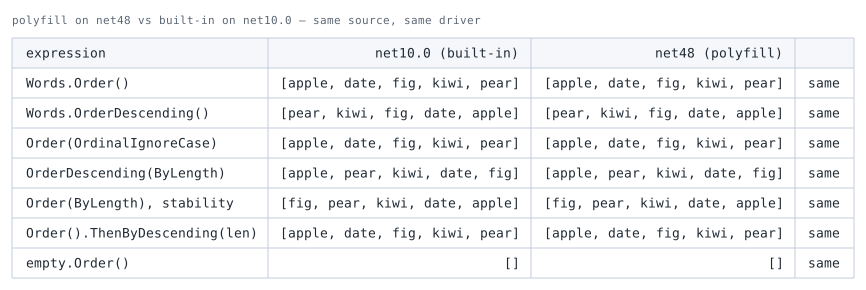
net48 and built for net10.0 where #if switches it to the built-in, run through one and the same driver. Measured with .NET SDK 10.0.302.The two sides agree down to the ordering of elements the comparer treats as equal, which is preserved (a stable sort). That ThenByDescending can be chained onto the result is also evidence that the return value is an IOrderedEnumerable<T>.
Because the delegation style contains no yield return, the validation/iterator split required for hand-written iterators (principle 1 of the foundation article) does not apply.
The source null check runs immediately at call time, while the sort itself stays lazy through the delegated OrderBy.
Since the work is handed to a proven existing API, there is no room for algorithmic bugs to creep in.
Basic usage looks like this.
var numbers = new[] { 3, 1, 4, 1, 5, 9, 2, 6 };

var ascending = numbers.Order();
// ascending: 1, 1, 2, 3, 4, 5, 6, 9

var descending = numbers.OrderDescending();
// descending: 9, 6, 5, 4, 3, 2, 1, 1
The parameterless overloads use the element type’s default comparer (Comparer<T>.Default), so ordered types such as int and string sort as-is.
The IComparer<T> overloads swap in custom comparison logic.
var words = new[] { "banana", "Apple", "cherry" };

var sorted = words.Order(StringComparer.OrdinalIgnoreCase);
// sorted: Apple, banana, cherry
Compatibility Question 1: The Return Type IOrderedEnumerable<T> Decides ThenBy Chaining
The one real design decision in this delegation polyfill is the return type.
Returning IEnumerable<T> produces the same sorted output, but the original Order returns IOrderedEnumerable<T>, which allows a secondary sort key via ThenBy / ThenByDescending.
var words = new[] { "Banana", "apple", "banana", "Apple" };

// Sort case-insensitively first; break ties with an ordinal comparison
var result = words.Order(StringComparer.OrdinalIgnoreCase)
                  .ThenBy(s => s, StringComparer.Ordinal);
// result: Apple, apple, Banana, banana
Under the first key (case-insensitive), "Apple"/"apple" and "Banana"/"banana" tie, so the second key (ordinal) decides their order.
With an implementation that narrows the return type to IEnumerable<T>, this ThenBy fails to compile.
The delegated OrderBy already returns IOrderedEnumerable<T>, so all the polyfill has to do is not narrow it.
The general lesson for delegation-based polyfills: expose exactly the type the delegate returns and never drop information — that is the condition for API compatibility.
Compatibility Question 2: Sort-Time Exceptions Differ per Runtime
The parameterless overloads depend on Comparer<T>.Default, so for element types that implement neither IComparable nor IComparable<T>, the sort throws at the point it actually compares two elements.
Empty and single-element sequences perform no comparison and therefore do not throw; the failure surfaces only once two or more elements require an actual comparison.
Which exception type surfaces depends on the runtime.
- The default comparer itself throws
ArgumentException(message: “At least one object must implement IComparable.”). - On .NET Framework,
OrderBydoes not wrap comparison exceptions in its internal sort, so thisArgumentExceptionpropagates as-is. - On .NET Core 3.0 and later (including the built-in .NET 7
Order), the internal sort wraps comparison exceptions inInvalidOperationException(message: “Failed to compare two elements in the array.”, with theArgumentExceptionas the inner exception).
In other words, while this polyfill runs on .NET Framework, its exception type does not match the built-in .NET 7 behavior.
This is a structural limit of delegation-based polyfills: the delegate’s behavior surfaces unchanged, so wherever the delegate itself differs from modern .NET, the polyfill cannot paper over it.
Code that handles exceptions by type should account for this difference during migration; better yet, pass an explicit IComparer<T> whenever sorting arbitrary types.
Migration Guard
The polyfill is wrapped in #if !NET7_0_OR_GREATER.
Order / OrderDescending do not exist before .NET 7, so guarding with !NETCOREAPP or !NET6_0_OR_GREATER would disable the polyfill in .NET 5 / .NET 6 builds and break compilation.
The general rule — disable at and above the version that introduced the methods — is laid out in the .NET 6 backport article.
Caveats
- Sorting is stable: the underlying
OrderByis a stable sort, so elements with equal keys keep their input order. This matches the built-inOrder. - Evaluation is lazy: like
OrderBy, the sort runs atforeach/.ToList()time. TheArgumentNullExceptionfor anullsource is thrown immediately at call time. - Prefer explicit comparers over the default: as described above, the parameterless overloads throw at runtime for types with no defined ordering. Pass an
IComparer<T>when the element type is arbitrary.
Alternatives / Comparison
| Approach | Pros | Cons | Best for |
|---|---|---|---|
| Delegation polyfill (this article) | A few lines; no algorithmic bugs possible | Cannot reproduce behavior the delegate itself lacks (exception type) | Using the Order spelling before migrating |
Write OrderBy(x => x) inline |
No extra code | Verbose; mass replacement needed when moving to Order |
Few call sites and no migration planned |
| Upgrade to .NET 7 | Root fix plus language features | Migration cost | When migration is feasible |
Writing OrderBy(x => x) inline works fine today, but consolidating to Order after a .NET 7 migration means hunting down and replacing every call site.
With the polyfill in place, code uses Order from day one, and conditional compilation switches to the built-in implementation automatically at migration time.
Summary
The Order / OrderDescending polyfill is the minimal possible implementation — pure delegation to an existing API.
Its quality therefore hinges on compatibility, which reduces to two points.
| Question | Decision |
|---|---|
| Return type | Keep IOrderedEnumerable<T> to preserve ThenBy chaining |
| Sort-time exceptions | Types differ from .NET 7 while running on .NET Framework; avoid by passing an explicit IComparer<T> |
Choosing between a hand-written iterator polyfill (foundation article) and this delegation style comes down to whether the target behavior is expressible by composing existing APIs.
When it is, delegation is the safer choice; write an iterator only when it is not.
Related Articles
- Designing LINQ Polyfills That Preserve Lazy Evaluation — Implementing Append, Prepend, TakeLast and SkipLast
- Replacing GroupBy and Full-Sort Workarounds — Implementing Chunk, MaxBy, MinBy and DistinctBy
- Selector-Free ToDictionary — Designing for Overload Resolution and the notnull Constraint
- Key-Based Aggregation Without GroupBy — Dictionary-Backed CountBy, AggregateBy and Index
- Expressing SQL Outer Joins in LINQ — Implementing LeftJoin, RightJoin and Shuffle